[Profile / History]
Feb. 20th, 2014 10:10 pm![[personal profile]](https://www.dreamwidth.org/img/silk/identity/user.png) rupert_hentzau
rupert_hentzau□ Name: Count Rupert of Hentzau
□ Journal: rupert_hentzau
□ Series: Prisoner of Zenda (and its sequel, Rupert of Hentzau) by Anthony Hope
□ Canon point: End of the first book
□ Age: 22
□ Gender: Male
□ Appearance: Rupert is the very definition of the phrase ‘handsome devil’. He’s 22 in his book canon, and heartbreakingly attractive. Curly blond hair, trim figure, classically handsome features and a dashing grin. He dresses in the height of fashion from Europe in the late 1800s, reflecting both money and taste and just a dash of carelessness that gives him the look of having come fresh from the bedroom (which is true more often than not). He is represented by Alex Pettyfer, who is 5’11”.
□ History: A young nobleman of the worthy house of Hentzau, Rupert comes from a line of dashing, daring, clever and flirtatious nobles. Young Rupert grew up on stories of his forefathers, with both the promise of this is what you are and the weight of this is what you should be, such as his grand-uncle Frederick of Hentzau, aka the Bishop of Modenstein, from the prequel book by Anthony Hope: The Heart of Princess Osra. Being dashing, clever, and expert an swordsman is in Rupert’s blood—although most of his ancestors were as honorable as they are dashing.
As a boy, he was charming and charismatic, the type of child who could get away with anything and was more than a little spoiled because of it. He charmed tarts from the cook, kisses from the chambermaids (even if they were twice his age and him barely out of swaddling) and forgiveness from his mother no matter what his crimes. His father was disinclined to actively parent his son, and died while Rupert was still young, so there was no one but Rupert’s long-suffering mother to try and tame him.
She adored her son, and Rupert adored her, although even his devotion to her was not enough to keep him in line. Whenever she heard of his misdeeds, she scolded him by crying and asking how he could be so wicked, and he earned forgiveness by kissing her cheek and promises her that he would truly try to be good. Those promises faded the moment he was out of his room, and his mother adored him too much to lift any finger to prevent his wickedness.
If the House of Hentzau had been as rich as it once had been, Rupert would have become petulant and lazy. But as it was, Rupert inherited his father’s name and poverty, and was forced to become clever in order to afford the lifestyle he wanted. As a boy, he stole, embezzled, and gambled from his relations and fellow nobles for money. As he got older, he got smarter and more ambitious about the schemes he could run and connections he could exploit. Both careless and conniving, Rupert put just enough of his funds into his home and title in order to get himself the level of tutoring and swordsmanship he needed to advance his ambitions, and consistently blew all the rest of it on women and drink.
His mother was a devout, chaste and modest woman, and it agonized her to watch Rupert’s increasing wickedness. While she went about the house in chaste black and attended church regularly, Rupert advanced his pleasures and ambitions by throwing lavish gambling parties and filling the house with women. It’s specified that in the book, teenage Rupert broke his mother’s heart by keeping multiple mistresses in her house, to the shame of the noble name of Hentzau, and multiple characters accuse Rupert of killing her because of the shame and heartbreak.
It’s one of the few things that can genuinely guilt him, because he loved his mother despite how different their priorities and beliefs, and he hates the knowledge of all the sorrow he caused her. But most of all, it haunts him that she didn’t forgive him one last time. All through his childhood, she would cry over his wickedness but he always won her forgiveness. When he sat by her deathbed, she wept and worried for his soul, and he smiled and kissed her forehead, coaxing in his usual charming way in order to hear her usual ‘oh, Rupert, of course I forgive you’. Except that last time she wept, her eyes closed, and her last words had been of sorrow, not forgiveness. That was the first and only time in his life that he ever repented his wickedness, and he truly believes that he killed her. The memory remains an open wound, because some part of Rupert is still waiting for his dead mother to reply one last time that she forgives him.
Despite the single red drop of guilt in his heart, Rupert continued his ambitions unabated. He served as a nobleman in the Ruritanian army, given rank because of his title and then launching up the ranks because of his incredible skill for strategy and leadership.
By the age of twenty-two, Rupert was second-in-command to “Black” Michael Elphburg, the Duke of Strelsau, and aided him in masterminding a bid for the throne. Black Michael died at the treacherous hands of Rupert himself, in a quarrel over a woman (among other things), and Rupert escaped scot free to come back for more trouble in the sequel, but I pick him up from the end of the first book.
□ Personality: A line from the book describes that “young Rupert went about Satan's work with a smile in his eye and a song on his lip.” Shameless, dashing, flirtatious, and wicked as the day is long, Rupert has no end of charm and not even a drop of morals. In the book, he is presented as the wicked mirror of the protagonist: both of them are charming, accomplished, and even noble, but while Rudolf is honest and true to the core, Rupert hasn’t a shred of decency in his heart. It is all but explicitly stated in canon that he is bisexual, and ruins the honor of young women and men both without even a thought for his own honor. He flirts openly with the protagonist, tries to bed every pretty girl in the book (and succeeds with most). He has no sense of loyalty, ends up killing his own master over a woman, and tries repeatedly to murder the protagonist. And yet he is regarded by the author, the protagonist, and just about everyone else with a fond exasperation. The protagonist has a kind of fond "can someone please just hang that dapper bastard already" and he and Rupert have an ongoing “I’m going to kill you but I’m not going to stop flirting with you to do so.” Rupert will steal your wife and try to kill you, but he do so while flirting and sassing constantly.
□ Abilities/Powers: An adept horseman and an expert swordsman, Rupert is quick and skilled with a sword, a gun (although of course he’s only familiar with guns from his era), or unarmed combat. In the book, he takes on four men with swords and wins without breaking a sweat. No magical abilities: he’s human, despite how often he is accused of being either the spawn of the devil or the devil himself.
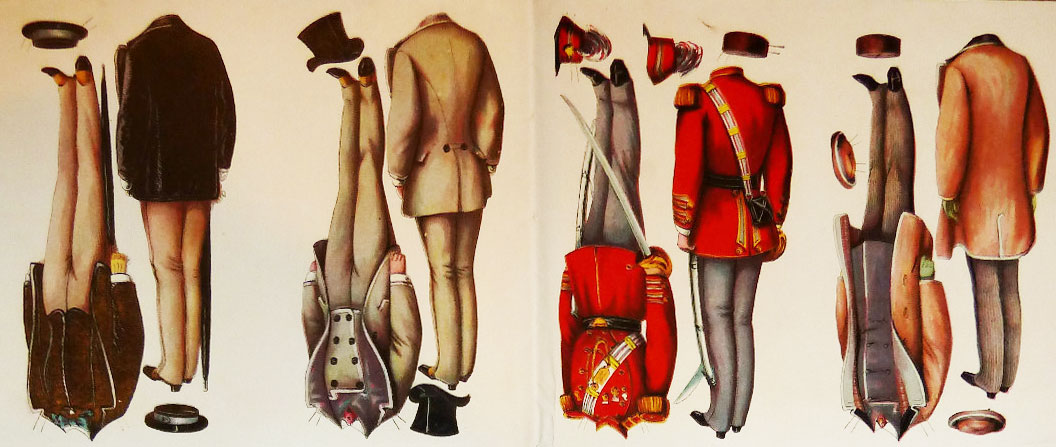
□ Personal Items: He carries an excellent sword of 19th century Ruritanian craftsmanship, and several exquisitely tailored suits in the height of aristocratic fashion from 1880s Bohemia.
Rupert in Parade Dress: http://4.bp.blogspot.com/-TDlR8mLUlqM/TtqqkYVgf_I/AAAAAAAAOos/TeBzYltTlHg/s1600/James-K-Hackett.jpg
Stylish suit: http://www.fashionbelief.com/wp-content/uploads/2013/01/Victorian-Clothing-Men.jpg
Bohemian Paper Dolls 1880s: http://19thcenturypaperdolls.weebly.com/uploads/9/6/2/7/962723/3027537_orig.jpg